The Swamps of Zambia: Watch What People Do
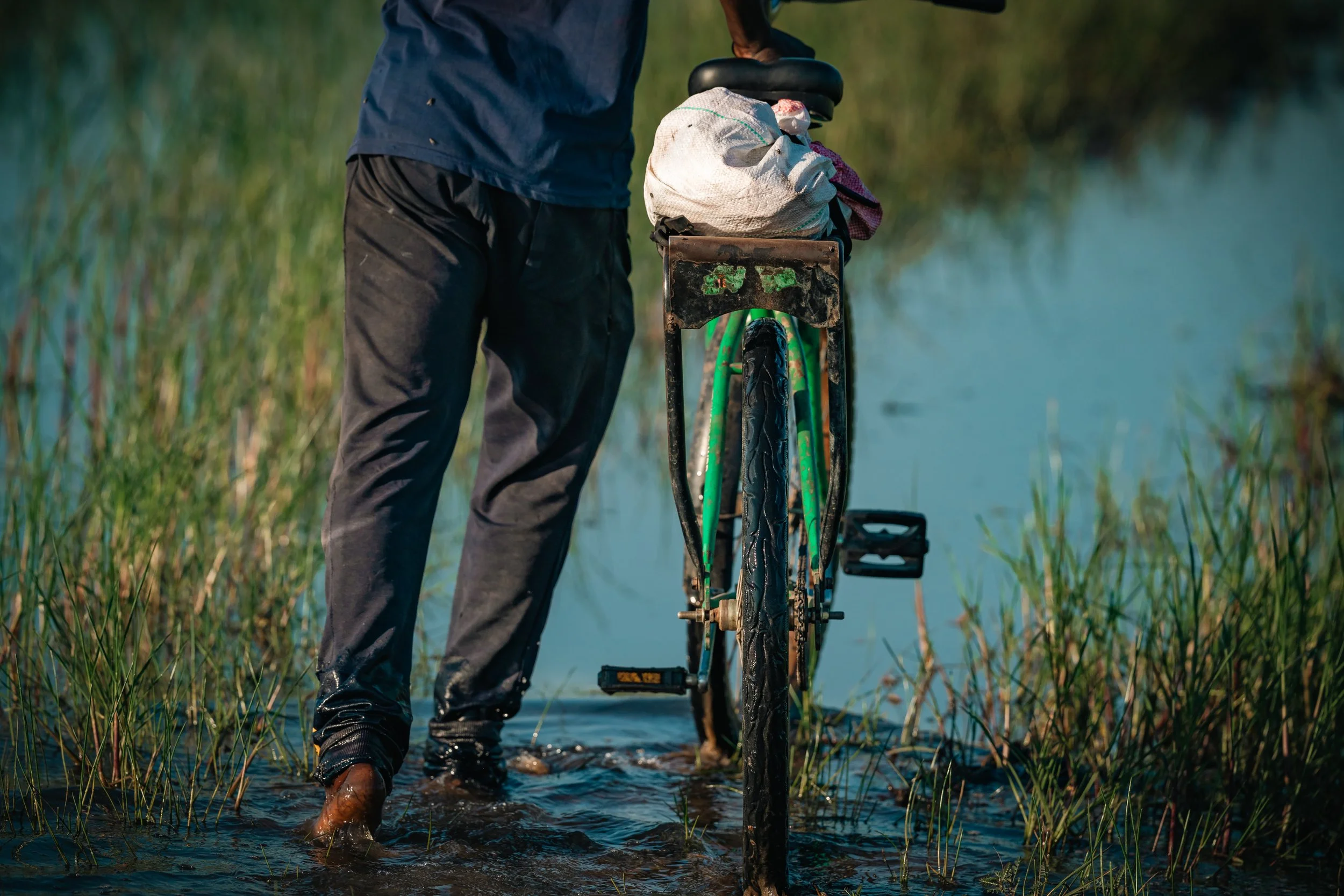
A man pushes his bike across Chilubi Swamp. Photo: Steve Kagia
The sun rises quite early in Northern Zambia around this time of year.
We had lodged at a small trading centre, called Chaba in Chilubi District, ‘a sizable room,’ I should say. I spent part of the first night wrestling what I can only describe as gigantic cockroaches.
Anyway, the trading centre is at the edge of a swamp that connects you to the massive lake Bangweulu. ‘Bangweulu’, I like that name, it sounds poetic. Doesn’t it? Also, we are told it means ‘the place where the water meets the sky.’ How wonderful! Stunning sunset, if you ever visit, by the way.
Chilubi is a kind of an island district wrapped in swamps and wetlands, and you learn quickly that the day doesn’t wait for you to be okay. Its different, dynamic world. So we are up at 4 a.m. The app tells me we will do 33 degrees that day, which doesn't account for the suffocating humidity that we would experience. Abeg.
We are with my crew- our brave little band of creatives, eager and naive -ish for what awaits! Our lead that morning was Vester*, a project officer, a wonderful man. And Mshipi, a man with an interesting name..in Bantu, that’s the name for ‘a belt’..which he proudly reminds us. He is in charge of the malaria programme in the district, and what an incredible job he does. I might just do a story on him.
We drove out as the morning light warmed up the horizon… It’s the onset of the rainy season here, and so you feel that crispness hug your face with the morning air.
At the edge of the swamp, in the East, there are group of thatched homes, where we meet some women already awake, pounding cassava, their sticks rising and falling in near-perfect unison. It is an incredible scene to view with that 5:30 am orange morning light backdrop.
This is where we leave our vehicles. We put on gumboots, very confident, very clueless. Because, honestly, we had no idea what to expect. I mean, we had a briefing, but still…. Vester said it would take about two hours to cross over. He said it casually, like he was describing a short stroll to buy airtime…. ‘he is managing us,’ I thought. I was right…that wise man!
And boy, was he right. It took us nearly three hours one way!
The swamp introduces itself, politely, then dramatically, then violently: The first few metres were decent, hard ground, manageable. The kind of terrain that tricks you into thinking you are having a day.
Then suddenly: mud
Then: water.
Then: deeper water.
Then: water that looks at your gumboots and laughs.
We wade clear water (clear, I should insist, just… psychologically confusing). We are told that occasionally snakes swim around… It's hearsay…But somewhere in there, as you wade, you see armies of leeches doing their own morning run. You try not to think too much about it, because if you do, your spirit will leave your body…also, there are more immediate needs, like not getting stuck in the mud, or getting left behind. You know?
We form ahuman line across the swamp, vaccine boxes, camera bags on backs, tripods and that awkward silence people have when they’re trying to look brave but are also imagining their insurance forms!
And in the middle of all that, it hit me: this is NOT a film crew assignment for the people here. This is normal life.
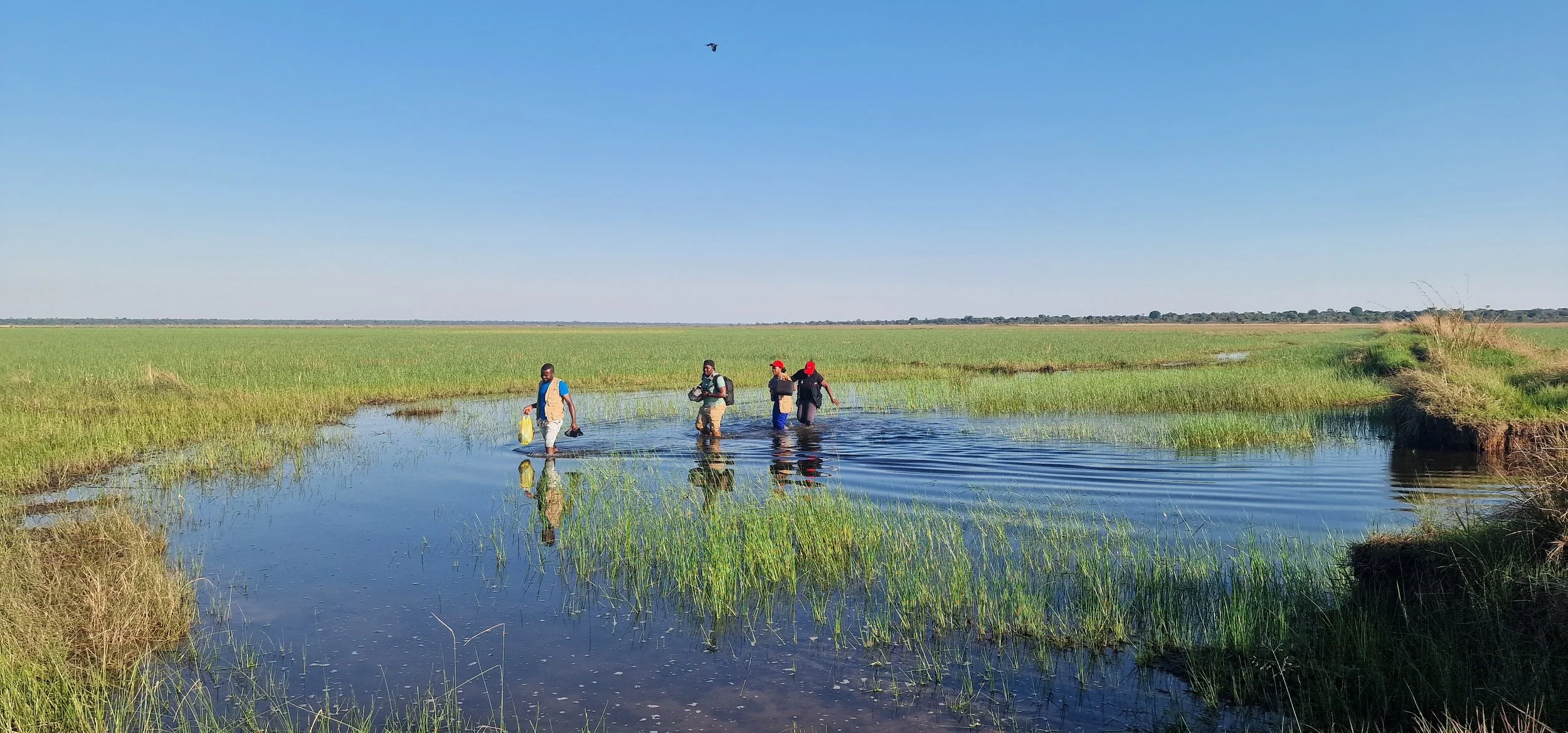
The ‘waders’
Which Health Services?
At some point, we removed our gumboots because they were absolutely useless. They were heavy. They were suctioned by the mud. They were basically expensive stress. So there we were: Water up to the waist, gumboots in our hands (yes, in our hands), bags on our backs, and Vester calmly narrating the reality:
In Chilubi, there are remote villages that require health services, and community health workers must cross water channels like these to reach them. Sometimes they cross to access vaccines, then they cross back again, because the children on the other side cannot wait. Think about this, since the small health centres do not have emergency care, what would happen if there were one? And you can bet, there’s always an emergency.
This district is highly endemic for malaria, so services have to reach. And where the roads end, that doesn’t mean the services stop- they still have to get there. It’s easy to say ‘healthcare should reach everyone’ in a conference room with AC. It’s different when your colleague Steve is literally stepping into deep water to get the shot.
Then came the part where the water got deeper than we could handle. Someone probably prayed. Quietly. I did, for one. And then, a small, broken canoe came to rescue us. That thing had no life in it. It looked like it had retired, came out of retirement, and then immediately wasnt sure it was a good idea. But it was Calvary. Our Calvary.
Water seeped in as we got in. Lots of water. So we were bailing water with small containers, vaccine boxes, and yes, our gumboots. If you’ve never used a gumboot as a bucket, you haven’t lived. And as we paddled and scooped and tried not to tip, I kept thinking: ‘people do this every day. Not for a documentary. But because life is on the other side.’
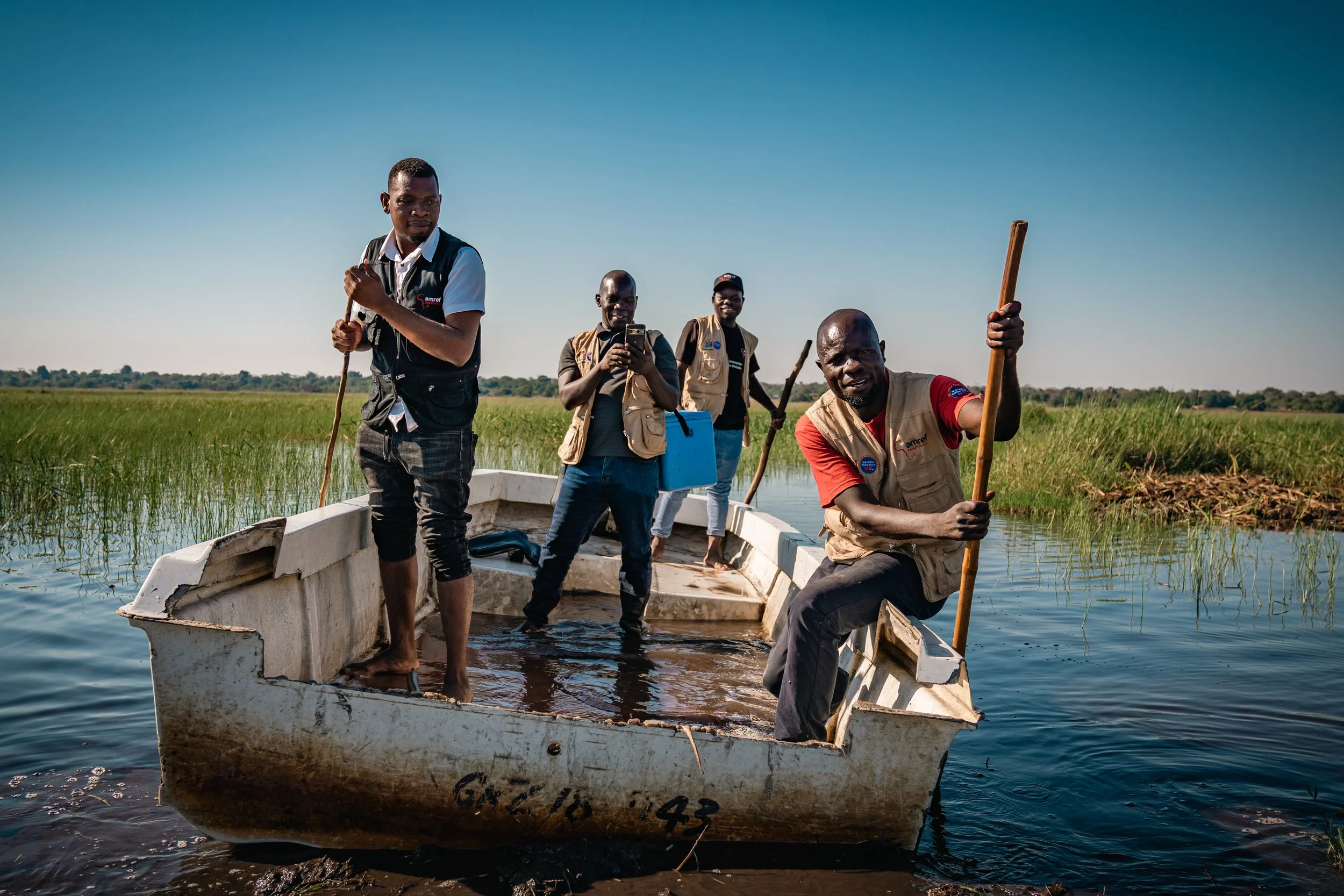
oh yea, the canoe! The team that makes it happen. Photo: Steve Kagia
Meet Imma:
On the way, we meet a community health worker named Imma, superhuman, I must add. Imma was amputated when he was a baby, just 10 months old. He is now 38. (Packaging story about this man, so keep an eye out.) Anyway, he crosses these swamps with a stick. He told me how, sometimes, the stick gets stuck in the mud and he gets stuck too. But he doesn’t stop, he adds. You have to move…We take the journey across with him, ‘I move more slowly than others, ’ he says, ‘but you know, Malaria doesn’t slow down because there are no roads!’ That is the reality in places like Chilubi: mosquitoes do not care about terrain. Fever does not wait for transport. And a child can tip from ‘just hot’ to severe malaria, frighteningly fast
Other times, he tells me, he uses a bicycle; except in the deeper parts of the swamp, he has to carry it on his shoulder. How about that! A man with one leg, carrying a bike to deliver health services. As he spoke, my brain tried to picture it and failed. It simply refused. Because some realities don’t fit neatly in your imagination, especially if your imagination is used to thinking, ‘This Wi-Fi is super slow, I’m suffering.’ Suddenly, my whinnings oscillate on a superficial radar.
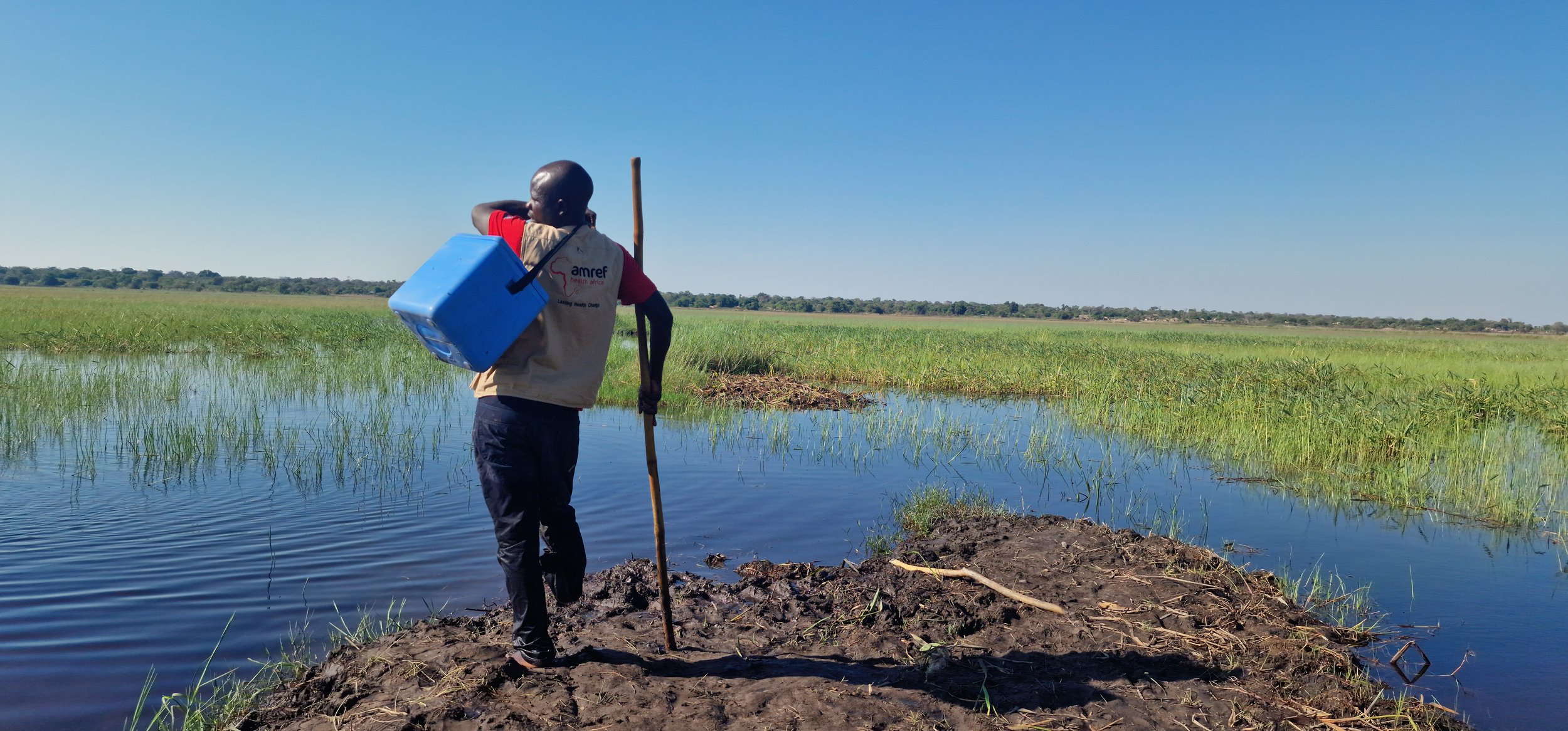
Imma, the man, the legend, the health worker.
Imma and his colleague Gilly cross because mothers and children will not wait. Vaccines will not teleport. Malaria will not pause because there’s no road. And pregnant mothers, quite literally, cannot afford delay.
The swamp has lessons… besides humility: There are stories, hard stories, that Imma narrates, of families trying to cross while carrying a sick child suffering from Malaria, and tragedy meeting them halfway. Their child dies on the way. …on water, surrounded by swamp, and croaking frogs.
The weight of it all.
Who bears hope?
But here’s the thing: even in the middle of this nightmare, hope is stubborn, I submit.
Hope looks like a health worker limping for over an hour through water to pick up vaccines, then walking back again because ‘delivered.’
Hope looks like a leaking canoe that still makes the trip. Hope looks like Imma, stuck in mud sometimes, but never stuck in spirit.
And hope also looks like Chilubi, the beautiful island set inside one of Zambia’s great wetland systems, where the seasons shape life, movement, work, and survival.
I won’t lie: I complained a little afterthat journey to and fro… My legs and pants felt like they were made of wet cement. My socks were doing things socks should never do.
But that day handed us a mirror, or at least I hope.
Because we often cry about small inconveniences- slow internet, cold coffee, a delayed meeting, while somewhere, someone is measuring distance in hours of wading, not kilometres of road.
Limitation is often perceived. And then, Chilubi comes and says, “Yes…. sometimes limitation is also very real. But watch what people do anyway.”
They wake up. They move. They carry. They deliver.
Not just for themselves, but for others. For children. For mothers. For communities trying to live full lives in places where access is not a buzzword, it’s a daily battle.
Photos by brilliant Steve Kagia